

Meet Navi: Your 24/7 AI Instructor Inside the MLS Classroom
Unlock 24/7 access to Navi, an AI instructor trained on MLS course material, so you can ask questions, run practice quizzes, and nail your captain’s exam.
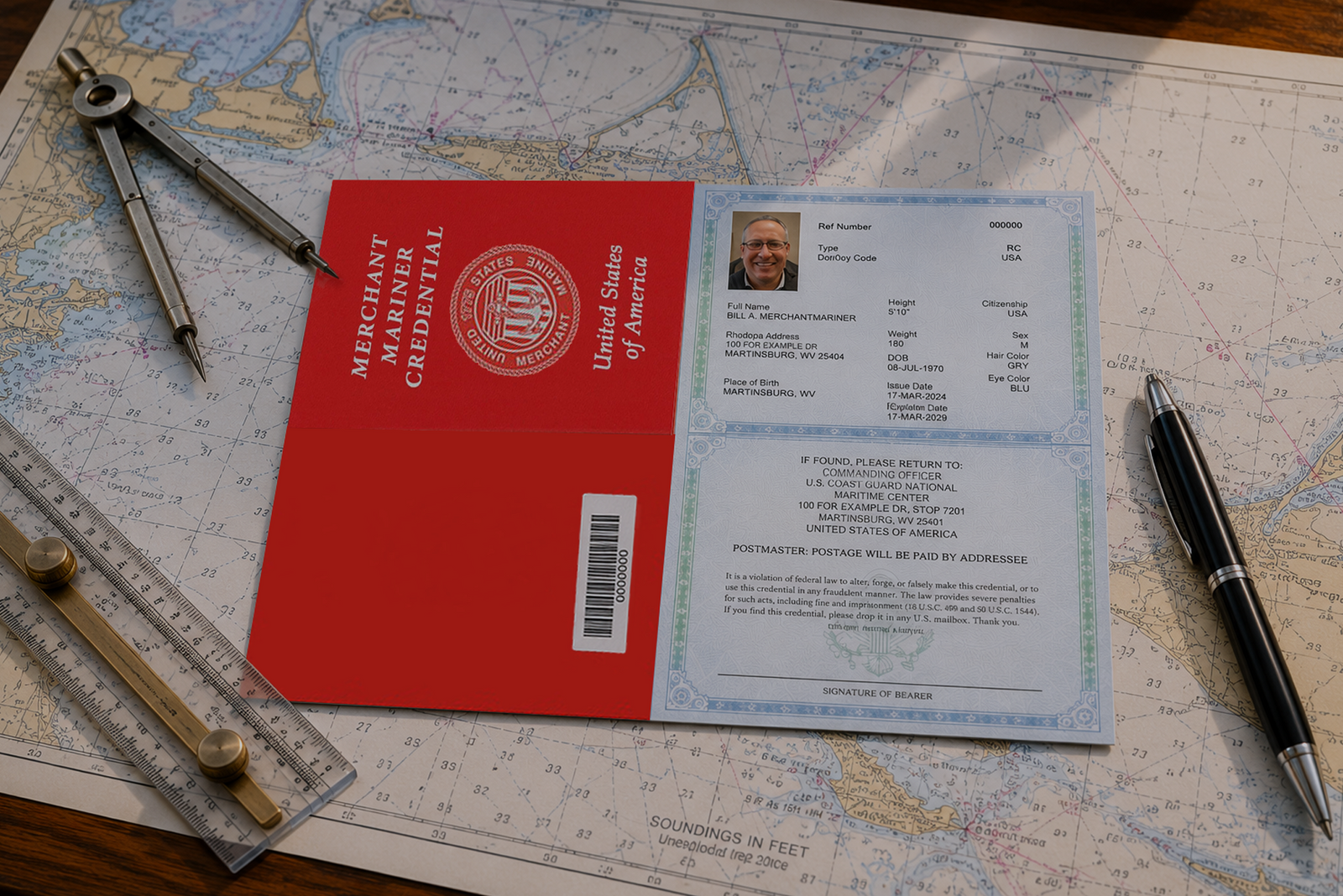

The Merchant Mariner Credential (MMC) is the official document behind your USCG captain’s license, issued by the National Maritime Center. Since March 1, 2024, it’s printed on flat, Tyvek-like paper, not the old red passport book. It’s valid for five years and isn’t legitimate until you sign it.
Your license arrives, and it doesn’t look like the credential you pictured. The Coast Guard changed the format in 2024, so the document in your hands is flat paper, not the old red book many captains still describe.
That’s normal, and it’s official. Here’s what your Merchant Mariner Credential looks like now, what to do the moment it arrives, and how long it lasts.
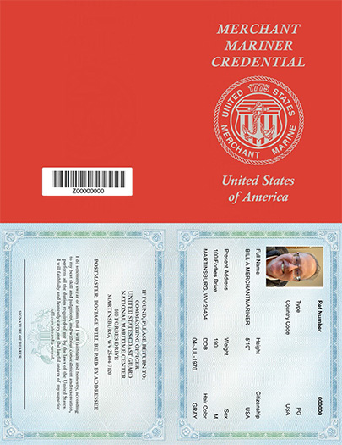
For decades, the credential came as a passport-style red book with stick-in endorsement labels. That changed in 2024. On March 1, 2024, the Coast Guard began issuing the Merchant Mariner Credential (MMC) in a new format, a flat, Tyvek-like paper document that replaced the red passport book and its endorsement labels.
If your credential looks like a sheet rather than a booklet, you have the current version.
The change is cosmetic, not a change to what your credential authorizes. Your endorsements and authority carry over exactly as before.
If the terms still blur together, our explainer on the Merchant Mariner Credential and the captain’s license sorts out who issues what.
Here’s how the formats compare.
|
Feature |
Old Credential |
New Credential (Since March 1, 2024) |
|
Format |
Passport-style red book |
Flat, Tyvek-like paper |
|
Endorsements |
Stick-in labels |
Printed on the document |
|
Authority Granted |
Same |
Same |
|
Validity |
Five years |
Five years |
The new MMCs are formatted on 8.5" by 11" waterproof and tear-resistant synthetic paper.
Because the Coast Guard retired the red booklet in 2024. The flat, Tyvek-like document is the current official format. It carries the same authority the old book did.
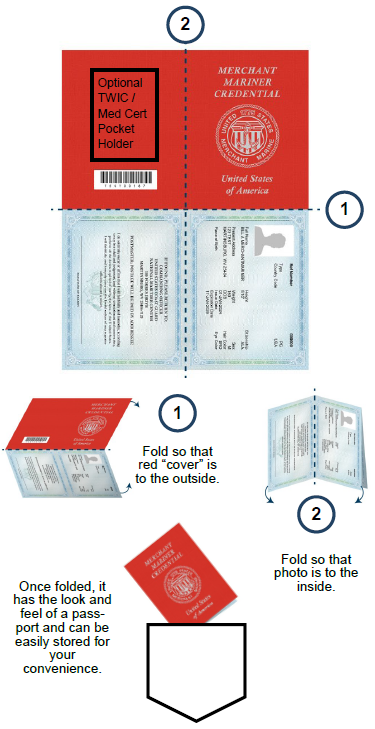
The MMCs can be displayed either flat or folded. Folding is optional; not required. For your convenience, the National Maritime Center will include a pocket with your MMC. It may be used for storing your Transportation Worker Identification Credential (TWIC) and Medical Certificate.
If you choose to fold, follow these guidelines:
Endorsements will no longer be provided as separate labels (e.g., stickers); instead, a new MMC document will be issued that includes endorsements.

A new credential isn’t ready to use straight out of the envelope, and one missed step leaves it invalid. The moment your Merchant Mariner Credential arrives, verify every detail, report any error to the National Maritime Center, and sign it, because an unsigned MMC isn’t valid. Take a few minutes here to avoid a problem on the water later.
Work through these steps:
The signature step is the one people skip. Your MMC isn’t valid until you sign it, so treat signing as part of receiving it.
Your signature indicates acknowledgment of the content of the credential and your rights of appeal under 46 CFR 1.03-40, and this new info doesn’t need to be added in this exact spot if you see somewhere better.
For where this falls in the broader process, revisit our guide to submitting your application packet.
MMCs cannot be used as a passport. DO NOT laminate your credentials. Avoid any attempt to modify the document.
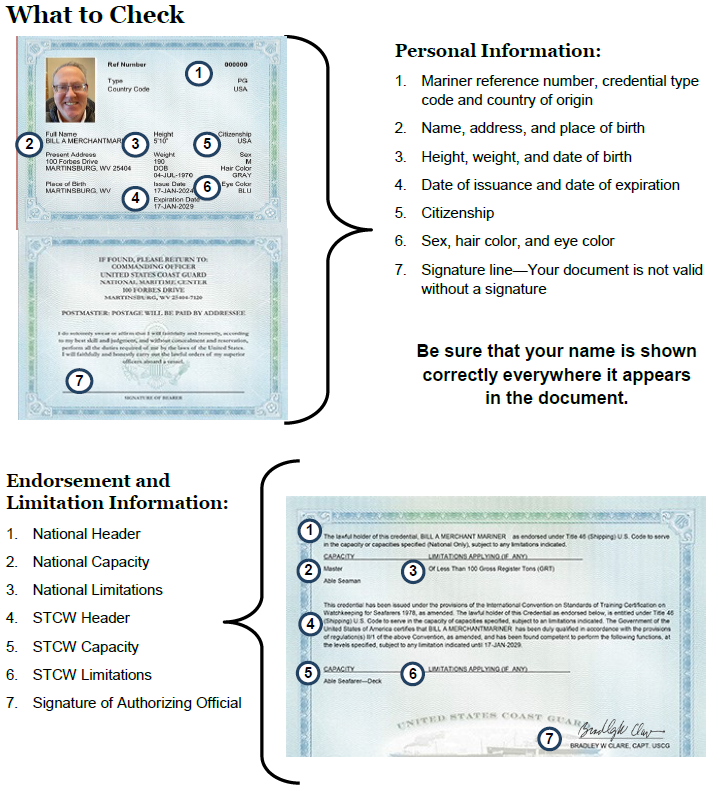
No. An unsigned Merchant Mariner Credential isn’t valid. Sign it with a black or blue ballpoint pen as soon as you verify the details are correct.

Your credential has a fixed lifespan, and federal rule sets it. A Merchant Mariner Credential is valid for five years from its date of issuance under 46 CFR 10.205, after which you renew it to keep operating. Plan your renewal before the expiration date rather than after.
If you miss the date, the Coast Guard allows an administrative grace period of up to one year beyond expiration to renew. You can’t serve under an expired MMC during that window, so renewing on time is the cleaner path.
When the time comes, our walkthrough of how to renew your captain’s license covers the steps and the sea service options.
Five years from the date of issuance, per 46 CFR 10.205. A grace period of up to one year lets you renew after expiration, but you can’t operate under the credential until you do.
NOTE: The Coast Guard temporarily extended the grace period, so if you’re approaching expiration, contact the NMC to see whether that bulletin is still active.
Legacy credentials remain valid until the indicated expiration date. Use the National Maritime Center Credential Verification on uscg.mil to confirm the validity of your credential.
Two cards confuse a lot of new captains, and they do different jobs. The Merchant Mariner Credential (MMC) is the document that authorizes you to operate, while the Transportation Worker Identification Credential (TWIC) is the TSA-issued identity card that serves as your primary identification as a mariner. You hold both, and they aren’t interchangeable.
The MMC proves what you’re qualified to do. The TWIC proves who you are and is the card you produce when an official asks for identification.
Here’s the distinction at a glance.
|
|
Merchant Mariner Credential (MMC) |
TWIC |
|
Issued By |
National Maritime Center (USCG) |
Transportation Security Administration (TSA) |
|
Purpose |
Authorizes your operating privileges |
Confirms your identity and security clearance |
|
Format |
Flat, Tyvek-like paper document |
Plastic photo ID card |
|
Role |
The credential behind your captain’s license |
Your primary identification document as a mariner |
For fees, eligibility, and how to apply, see our guide to the TWIC card.
No. The MMC, issued by the Coast Guard, authorizes your operating privileges, while the TWIC, issued by the TSA, is your identity card. You hold both, and you carry the TWIC as your primary identification.
Mistakes and mishaps happen, and the fix runs through the same office that issued the credential. If your Merchant Mariner Credential arrives with an error, or it’s later lost or damaged, contact the National Maritime Center to request a correction or a replacement. Don’t keep using a credential you know is wrong.
Report an error as soon as you spot it, before you rely on the document. For a lost or damaged MMC, the NMC issues a duplicate so you’re not left without a valid credential.
A quick look at our application requirements guide shows the supporting documents the NMC keeps on file for your credential.
It’s the official document the Coast Guard issues that holds your captain’s license authority and endorsements. Most people call it a captain’s license, but the National Maritime Center calls it an MMC. See our overview of the captain’s license and the MMC for the full picture.
Since March 1, 2024, the MMC is a flat, Tyvek-like paper document. It replaced the old passport-style red book and its stick-in endorsement labels.
Five years from the date of issuance, under 46 CFR 10.205. A grace period of up to one year allows renewal after expiration, but you can’t operate under an expired credential.
Yes. An unsigned MMC isn’t valid. Sign it in black or blue ballpoint pen once you confirm the details are correct.
The MMC, issued by the Coast Guard, authorizes your operating privileges. The TWIC, issued by the TSA, is your identity card and primary identification. You hold both.
The flat paper in your hands carries every bit of the authority the old red book did. Once you verify your Merchant Mariner Credential, sign it, and note your five-year expiration, it’s ready to put to work. The format changed; what you worked for didn’t.
From here, sign your credential, store it safely, and mark your renewal date on the calendar so it never catches you off guard. When that date approaches, you’ll know exactly how to renew your captain’s license and keep operating.
If you have questions about your Merchant Mariner Credential or any other part of the application process, the team at Mariners Learning System is here to help. We’ve guided more than 200,000 students through this process, and we’re not going to let paperwork be the reason you don’t get your license.
Ask a question, share an experience, or add a helpful tip related to this article. Comments may appear after review to prevent spam.
Unlock 24/7 access to Navi, an AI instructor trained on MLS course material, so you can ask questions, run practice quizzes, and nail your captain’s exam.


Learn what questions to ask and how to prepare for a captain’s license drug test to ensure you avoid the most common application delays.
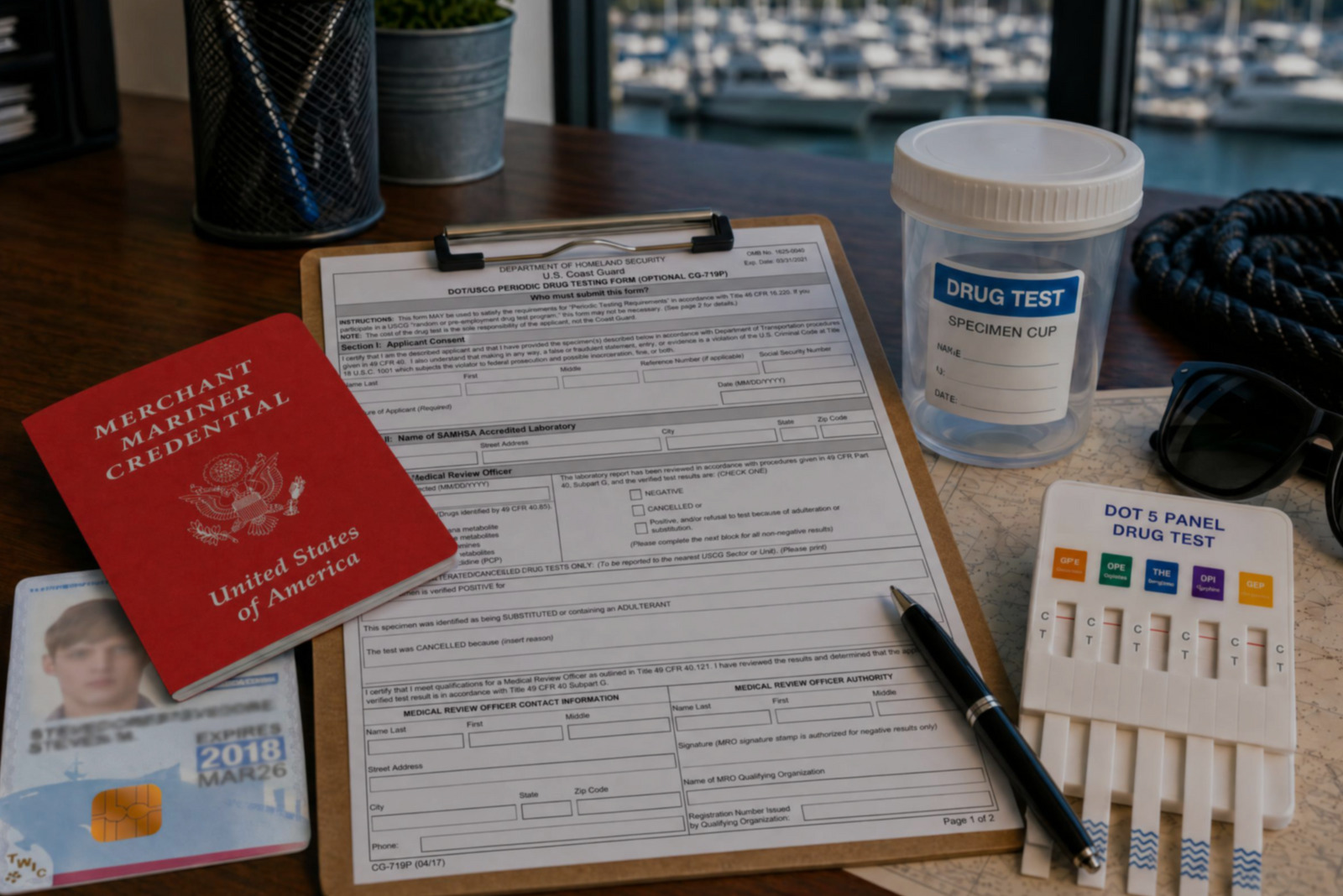

Discover the three types of drug tests working captains must submit to even after they’ve met the initial USCG drug testing requirements for their license.

Discover how a retired airline pilot became obsessed with the Great Loop and built a thriving captain training business through Mariners Learning System.


Learn which substances the MMC drug test looks for, plus how masking agents and false positives factor in.


Discover the five most common mistakes mariners make on the captain’s license physical, plus a checklist for how to avoid them.

Discover why so many charter captains run out of money and how to plan every startup cost from your vessel purchase to guest-ready outfitting.


Learn how to build a charter business plan that covers pricing, expenses, and marketing so your captain’s license leads to lasting profit.


Transform how you talk about price with proven anchoring strategies and value-first framing that stops charter guests from shopping around.


Discover how charter captains use hybrid pricing models and seasonal adjustments to increase revenue and simplify bookings for every guest type.