

Meet Navi: Your 24/7 AI Instructor Inside the MLS Classroom
Unlock 24/7 access to Navi, an AI instructor trained on MLS course material, so you can ask questions, run practice quizzes, and nail your captain’s exam.
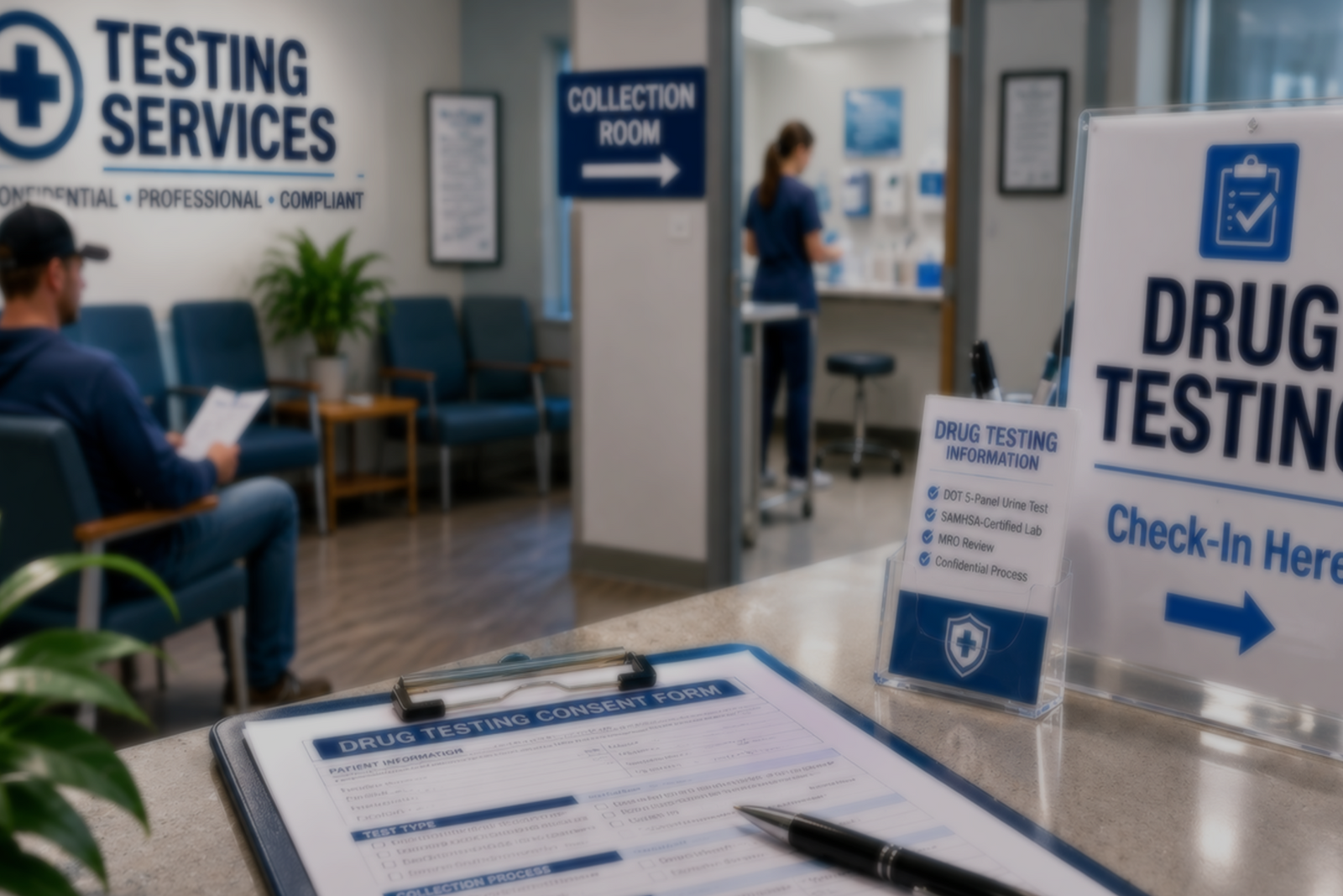

A DOT 5-panel urine test is required for every captain’s license application and renewal, screening for marijuana, cocaine, opiates, phencyclidine (PCP), and amphetamines. The test must be conducted within 185 days of your application date per 46 CFR 16.220, at a SAMHSA-certified lab, and reviewed by a Medical Review Officer (MRO).
Every captain’s license applicant and every mariner renewing their Merchant Mariner Credential (MMC), the credential behind the captain’s license, has to pass a drug test. It’s not complicated, and the rules don’t change based on which license you’re after.
But the details matter. Where you go, what test you take, and how you submit the results all follow a specific federal process. Get any piece wrong and your application stalls.
Here’s how it works.
The U.S. Coast Guard (USCG) requires a drug test for all original, renewal, and raise-of-grade applications for an MMC. That includes the OUPV/Six-Pack captain’s license, the 25/50/100-Ton Master captain’s license, and every endorsement that goes on the credential.
The only exceptions are increases of scope, duplicates, and Standards of Training, Certification, and Watchkeeping (STCW) international endorsements.
Every USCG captain’s license, whether it’s an OUPV/Six-Pack or a Master, requires a negative drug test before the Coast Guard will process your application. If you’re renewing with a Sailing or Assistance Towing Endorsement only, or requesting a duplicate credential, you’re exempt. Everyone else tests.

Yes, a drug test is required for captain’s license renewals. The same rules apply: a DOT 5-panel urine test at a SAMHSA-certified lab, reviewed by an MRO, within the time window set by the Coast Guard. The specifications don’t change between your original application and your renewal.
The USCG captain’s license drug test is a Department of Transportation (DOT) 5-panel screening. “5-panel” means it checks for five categories of prohibited substances:
|
Substance Category |
Common Examples |
|
Marijuana (THC) |
All forms, including edibles and medical |
|
Cocaine |
Powder, crack |
|
Opiates |
Codeine, morphine, heroin (6-AM) |
|
Phencyclidine |
PCP |
|
Amphetamines |
Methamphetamine, MDMA (ecstasy), MDA, MDEA |
The captain’s license drug test screens for exactly five substance categories under 49 CFR Part 40, and only a test for those five will be accepted. A 7-panel or 10-panel test won’t work. The Department of Health and Human Services (HHS) limited DOT testing programs to 5-panel testing as of October 1, 2010, so any broader panel isn’t valid for your application.
This is a urine test. If a facility tries to draw blood, it’s the wrong test.
This is the single biggest issue we see at Mariners Learning System.
Recreational marijuana is now legal in many states, and medical marijuana programs are widespread. But a captain’s license is a federal credential issued by the United States Coast Guard. Federal law doesn’t recognize state marijuana laws, recreational or medical.
If THC appears in your urine sample, you fail, regardless of whether your state has legalized marijuana or whether you hold a medical card. A medical marijuana prescription doesn’t create an exemption. The Coast Guard follows federal regulations, and under federal law, marijuana remains a prohibited substance.
We’ve had students lose a full year of progress over a single use. A failed drug test during the licensing process can mean an extended waiting period before retesting, depending on how the Coast Guard handles your case.
By then, your course certificate may have expired. Your physical may have expired. One mistake creates a cascade.
Frequency doesn’t matter. The test detects the presence of THC, not the amount or how often you use it. If THC is in your system on test day, you fail.
You have three ways to satisfy the Coast Guard’s drug testing requirement per 46 CFR 16.220. Each option has specific documentation standards.

Most first-time applicants use Option One: get the test, get the results, and submit them with your application packet. Your test results are documented on CG-719P, the DOT/USCG Periodic Drug Testing Form, completed by the MRO.
Option One is the most common path: take a DOT 5-panel test within 185 days of your application date, at a SAMHSA-certified lab, and have the results reviewed and signed by an MRO. The National Maritime Center (NMC), the office that reviews mariner applications, will accept a completed CG-719P, a Federal Chain of Custody form, or a letter from the testing facility, as long as the required information is included.
The individual applicant must send the results. Include your results in your complete application packet when submitting to the Coast Guard.
Not every drug testing location meets Coast Guard requirements. Before you schedule a test, call the facility and ask: “Do you offer the DOT 5-panel drug test with a Medical Review Officer review for a Coast Guard captain’s license?”
Confirm these three points with any facility:
You can’t take the drug test at a Regional Exam Center (REC). RECs don’t perform drug tests. You’ll need an independent DOT-approved facility, which you can locate through your preferred search engine or the Foley DOT Collection Site Locator.
Your drug test is self-paid; the facility sends results back to you, and you include them in your application.
You can’t receive a USCG captain’s license if you fail or refuse to complete the required drug test. The consequences extend well beyond a delayed application.
For applicants who haven’t yet earned their license, a failed test means a mandatory waiting period before retesting. For active licensed captains, a positive result on a random or periodic test triggers removal from duty. The Coast Guard may initiate Suspension and Revocation (S&R) proceedings before a federal Administrative Law Judge (ALJ), which can result in license suspension or permanent revocation.
A failed drug test can cost you your captain’s license and your ability to operate commercially, whether you’re a first-time applicant or a 20-year veteran. Positive test results must be reported to the nearest Coast Guard Sector, and the Coast Guard determines what enforcement actions follow.
Masking agents won’t help. The Coast Guard tests for them, and their presence in your sample counts as a failure with the same consequences.
No. A negative dilute result won’t be accepted by the NMC, so you’ll need to retest. If you get a negative dilute, schedule another test as soon as possible.
Your drug test results are valid for 185 days from the date of collection under 46 CFR 16.220. This is the tightest deadline in the entire application process.
We recommend waiting until you’re near the end of your coursework before scheduling the test. Taking the test too early creates an artificial deadline. If life gets in the way and your application isn’t submitted within 185 days, you’ll need to test again.
Plan your drug test for the final weeks of your coursework so you have maximum time to compile and submit your full application before the 185-day window closes.
Passing the initial drug test gets your license. Keeping it while working professionally requires ongoing compliance.
If you plan to use your captain’s license commercially, you must enroll in a USCG random drug testing program, called a consortium. This requirement applies to crew members, too.
Consortiums typically cost between $40 and $80 per year. Your name goes into a pool, and names are drawn at random intervals.
If called, you typically have 72 hours to report for testing, though documented circumstances like travel may allow a brief extension. Failure to comply counts as a refusal, which carries the same penalties as a positive test result. The current random testing rate for USCG crew members is 50% annually under 46 CFR 16.230(e).
If you use your captain’s license commercially, enrollment in a random drug testing consortium isn’t optional. If you hold your license for personal knowledge and safety only and never operate commercially, you don’t need to enroll in a random program, though you’ll still need to pass a test at each renewal.
The Coast Guard requires you to disclose all past drug-related convictions, DWIs, and DUIs on your application. A single old conviction won’t automatically disqualify you, but patterns of behavior and dishonesty will. Disclose everything honestly on Form CG-719B; the Coast Guard likely already has the information.
The collection itself takes about 30 minutes at most facilities. Results are typically available within 24 to 48 hours after specimen collection. Confirm the exact timeline with your testing facility.
CBD products are not regulated as strictly as THC, but some contain trace amounts of THC that can trigger a positive result. If you’re preparing for your captain’s license drug test, avoid all cannabis-derived products in the weeks before testing.
The drug test is self-paid and typically costs $75 to $150, depending on the facility. This is separate from your course tuition and Coast Guard application fees.
The captain’s license drug test is one of the most straightforward pieces of the application process. The rules are clear, the test is simple, and the timeline is predictable. Where people run into trouble is when they don’t pay attention to the details.
Know the 185-day window and go to the right facility. Don’t assume state marijuana laws protect a federal credential. Treat the drug test as a fixed checkpoint with no gray area, and you’ll clear it without a second thought.
If you have questions about the drug test or any other part of the application process, the team at Mariners Learning System is here to help. We’ve guided more than 200,000 students through this process, and we’re not going to let paperwork be the reason you don’t get your license.
Coast Guard forms and processes change. This guide reflects current USCG guidance as of June 2026, but always confirm requirements with the NMC. For questions on drug testing, contact the NMC customer service center at 1-888-427-5662.
Ask a question, share an experience, or add a helpful tip related to this article. Comments may appear after review to prevent spam.
Unlock 24/7 access to Navi, an AI instructor trained on MLS course material, so you can ask questions, run practice quizzes, and nail your captain’s exam.

Learn what questions to ask and how to prepare for a captain’s license drug test to ensure you avoid the most common application delays.
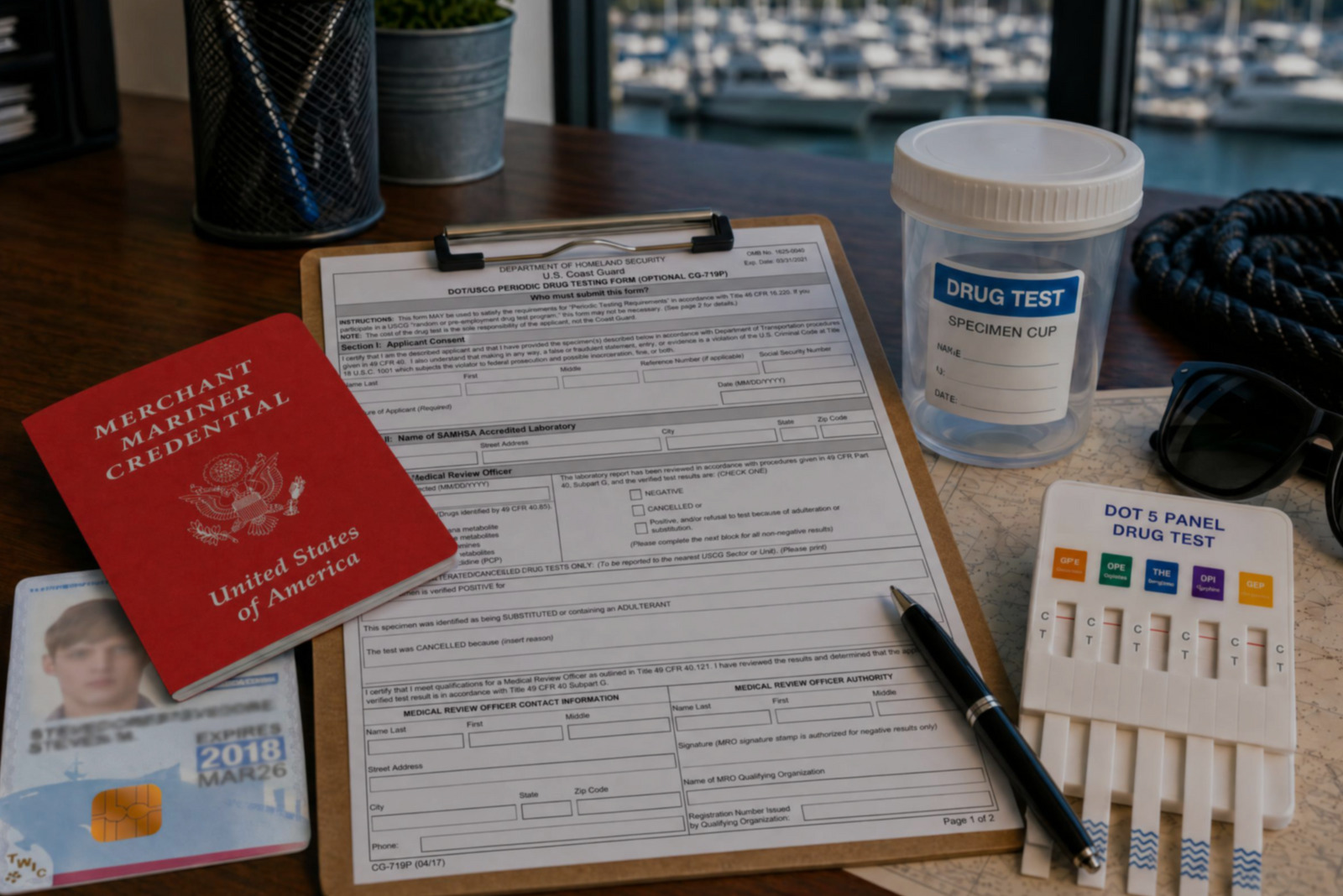

Discover the three types of drug tests working captains must submit to even after they’ve met the initial USCG drug testing requirements for their license.

Discover how a retired airline pilot became obsessed with the Great Loop and built a thriving captain training business through Mariners Learning System.

Learn which substances the MMC drug test looks for, plus how masking agents and false positives factor in.

Discover the five most common mistakes mariners make on the captain’s license physical, plus a checklist for how to avoid them.

Discover why so many charter captains run out of money and how to plan every startup cost from your vessel purchase to guest-ready outfitting.

Learn how to build a charter business plan that covers pricing, expenses, and marketing so your captain’s license leads to lasting profit.

Transform how you talk about price with proven anchoring strategies and value-first framing that stops charter guests from shopping around.

Discover how charter captains use hybrid pricing models and seasonal adjustments to increase revenue and simplify bookings for every guest type.