

Meet Navi: Your 24/7 AI Instructor Inside the MLS Classroom
Unlock 24/7 access to Navi, an AI instructor trained on MLS course material, so you can ask questions, run practice quizzes, and nail your captain’s exam.
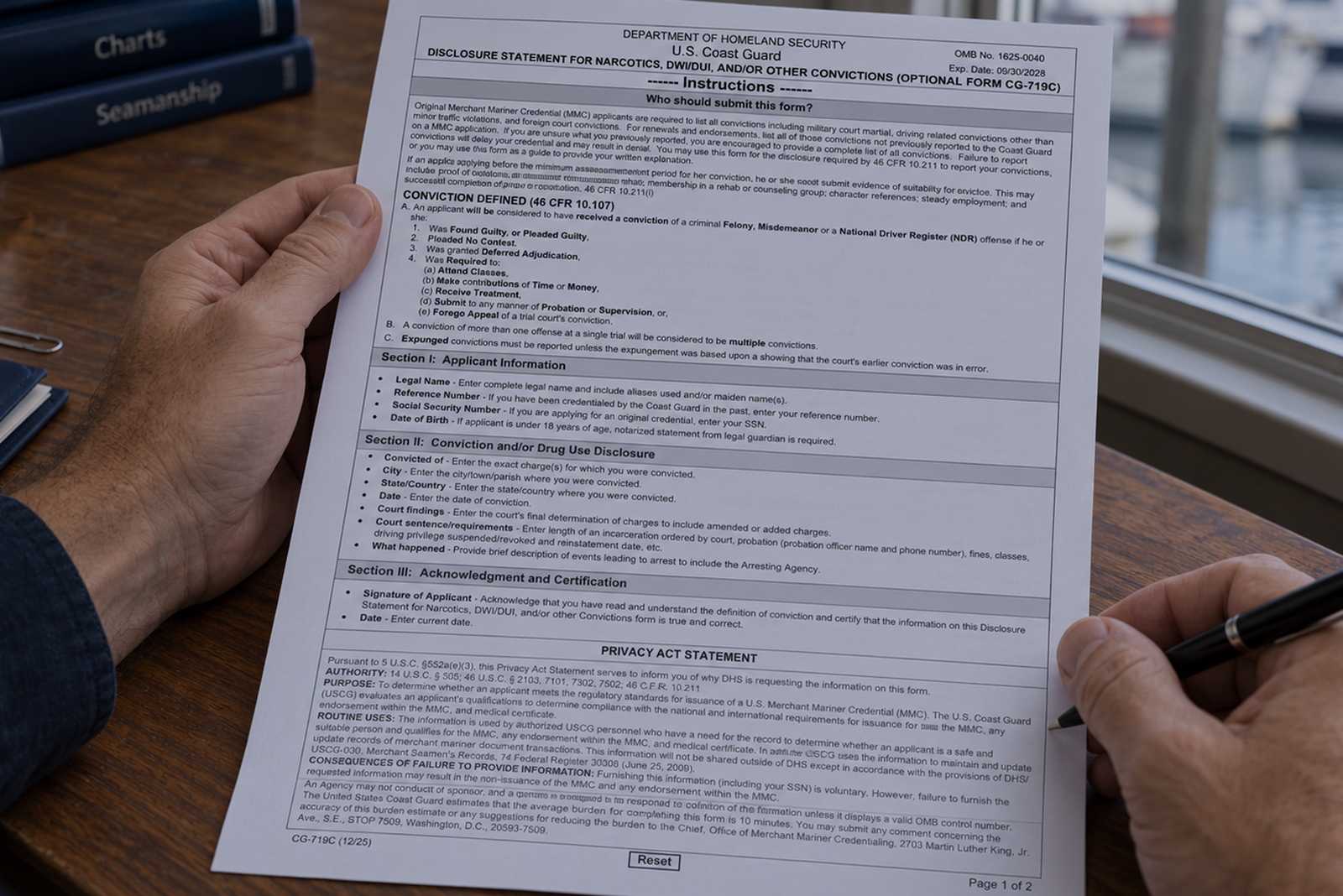

Form CG-719C is a disclosure form used to report criminal convictions, DWI/DUI offenses, and narcotics violations as part of a captain’s license application. Under the current process, you answer the Safety and Suitability questions in your Navita™ MMC application. If you answer “Yes” to a criminal record question, Navita™ automatically gives you the option to complete CG-719C online, upload supporting records, or do both.
A past conviction does not automatically disqualify you from earning a captain’s license. Failing to disclose required information, however, can delay your application and may result in denial.
The National Maritime Center (NMC) reviews criminal history as part of its Safety and Suitability evaluation. The Coast Guard also receives criminal record information through the Transportation Security Administration’s TWIC review process. Complete, accurate disclosure gives the NMC the information it needs to evaluate your application.
During the CG-719B Merchant Mariner Credential application, Navita™ asks criminal record and drug-use questions in Section III: Safety and Suitability.
Original applicants must disclose all prior convictions, including felonies, misdemeanors, military court-martial convictions, driving-related convictions other than minor traffic violations, and foreign court convictions.
Renewal, raise-of-grade, and endorsement applicants must disclose convictions that were not previously reported to the Coast Guard on an MMC application.
Applicants with no reportable history answer the questions accurately and do not need to complete CG-719C.
If you are unsure of what you previously disclosed, the Coast Guard encourages you to provide a complete list rather than risk omitting required information.
You do not need to download a blank CG-719C before starting your MMC application.
Sign in to the Navita™ Mariner Portal through Login.gov.
Start or resume your Merchant Mariner Credential (MMC) (719B) application.
Complete Section III: Safety and Suitability.
Answer every criminal record and drug-use question accurately.
If you answer Yes, finish the MMC application. Navita™ automatically launches the CG-719C disclosure at the end.
Complete the disclosure online and upload any supporting records requested by the application checklist.
Review the disclosure, electronically certify that the information is true and complete, and continue with the remaining MMC requirements.
Navita™ provides three ways to respond after a Yes answer:
Complete CG-719C online
Upload applicable supporting documents
Complete CG-719C and upload supporting documents
For most applicants with a conviction to explain, completing the online CG-719C and uploading the related court records provides the NMC with the clearest file.
For detailed instructions covering the entire MMC submission process, follow our guide to submitting your captain’s license application through Navita™.
Gather the details for every conviction you must disclose before starting the online form.
Be prepared to provide:
Your full legal name
Any aliases or maiden names
Your Mariner Reference Number, if you have one
Your Social Security number
Your date of birth
First-time applicants may not yet have a Mariner Reference Number.
If applicable, enter:
Type of drug
Month and year of last use
For each conviction, provide:
Exact charge
City and state or country
Date of conviction
Court findings, including a guilty plea, no-contest plea, or deferred adjudication
Court sentence and requirements, including incarceration, probation, fines, classes, license suspension or revocation, and reinstatement date
A brief explanation of what happened
Arresting agency
Whether you completed or remain in compliance with every court order
Provide a separate entry or additional documentation for each conviction. Do not combine unrelated events into one explanation.
Review the disclosure carefully before electronically signing it. Your certification confirms that you understand the Coast Guard's definition of a conviction and that the information you provided is true and complete.
Upload clear PDF copies of the records that explain each disclosed conviction. Depending on the case, these may include:
Charging documents or police records
Certified court disposition
Sentencing records
Proof that fines, classes, treatment, probation, or parole requirements were completed
Driver's license reinstatement records
Rehabilitation program records
Character references
Employment history or proof of steady employment
A personal statement explaining the circumstances and what has changed
If a record is unavailable, contact the court or agency that maintained it and keep documentation of your request. The NMC may ask for additional information during its review.
If the NMC requests another document after submission, sign in to Navita™, select Contact Us, and create a case that identifies the document and the application it belongs to. Open the case record and upload the requested PDF under the Files tab.
The Coast Guard’s definition of a conviction is broader than many applicants expect. Under 46 CFR 10.107, the following outcomes can count as convictions:
| Outcome | Counts as a Conviction? |
|---|---|
| Found guilty or pleaded guilty | Yes |
| Pleaded no contest | Yes |
| Received deferred adjudication | Yes |
| Required to attend classes | Yes |
| Required to contribute time or money | Yes |
| Required to receive treatment | Yes |
| Placed on probation or supervision | Yes |
| Chose to forgo an appeal of a trial court conviction | Yes |
A conviction for more than one offense at a single trial is treated as multiple convictions.
Deferred adjudication often causes confusion. Even if the matter was later dismissed after you completed a program, the Coast Guard may still treat the original disposition as a conviction.
Expunged convictions must also be reported unless the expungement was based on a finding that the original conviction was made in error. An expungement granted because you completed a sentence or program does not remove the Coast Guard disclosure requirement.
The Coast Guard evaluates criminal history under 46 CFR 10.211. The regulation establishes minimum and maximum assessment periods based on the offense.
The assessment period generally begins when the applicant is no longer incarcerated and may include periods of supervised or unsupervised probation or parole.
| Timing of Application | What the Regulation Provides |
|---|---|
| Before the minimum assessment period ends | You may apply, but you must submit evidence of suitability. Without it, the application is incomplete and will not be processed. |
| Between the minimum and maximum periods | The Coast Guard considers the conviction and generally grants the credential unless offsetting factors indicate the applicant is unsuitable. |
| After the maximum assessment period ends | The Coast Guard generally grants the credential unless it determines that the applicant remains unsuitable. |
Assessment periods vary by offense. Examples in 46 CFR 10.211 include:
Simple assault: 1-year minimum and 5-year maximum
Reckless driving: 1-year minimum and 2-year maximum
Burglary: 3-year minimum and 10-year maximum
Dangerous drug use or possession: 1-year minimum and 10-year maximum
Dangerous drug trafficking: 5-year minimum and 10-year maximum
Intentional homicide: 7-year minimum and 20-year maximum
The Coast Guard may assign an appropriate period to an offense not specifically listed.
Factors that may work against an applicant include multiple convictions, failure to comply with court orders, previous rehabilitation failures, inability to maintain steady employment, or a connection between the offense and the safe operation of a vessel.
Applicants who apply before the minimum assessment period has elapsed must submit evidence of suitability for merchant marine service. Evidence may also be important for alcohol-related, drug-related, or National Driver Register convictions.
Examples listed in 46 CFR 10.211(l) include:
Completion of an accredited alcohol or drug rehabilitation program
Active participation in a counseling or recovery group
Character references addressing sobriety, reliability, and suitability for maritime employment
Steady employment
Successful completion of parole or probation requirements
Applicants with a dangerous-drug conviction or history of dangerous-drug use must provide satisfactory evidence of suitability. A drug conviction more than 10 years old will not, by itself, be grounds for denial, but rehabilitation requirements may still apply.
DUI and DWI offenses must be disclosed. The Coast Guard evaluates applicable driving offenses through the National Driver Register under 46 CFR 10.213.
For an NDR-listed alcohol- or drug-related motor vehicle conviction:
One conviction less than one year old carries a one-year assessment period from the conviction date.
One conviction between one and three years old is generally processed unless a suspension or revocation remains in effect.
One conviction more than three years old is generally processed.
Two or more convictions may carry additional assessment requirements, particularly when one occurred within the previous three years.
The Coast Guard may still deny an application if the NDR information indicates that the applicant cannot be entrusted with the duties and responsibilities of the requested credential.
The NMC reviews your disclosure with the other Safety and Suitability information in your MMC application. This includes relevant criminal record information provided through the TWIC review process and information obtained through the National Driver Register with your consent.
The NMC may approve the application, request additional records, conduct a more detailed suitability review, or deny the application. If an application is denied, the Coast Guard must provide the reasons in writing and explain the applicable reconsideration and appeal procedures.
Complete disclosure is essential. An attempt to hide a conviction can create a more serious suitability concern than the conviction itself. Upload complete records from the beginning and respond promptly if the NMC requests more information.
Usually, no. When you answer Yes to a criminal record question in the Navita™ MMC application, the online CG-719C launches automatically at the end. The downloadable form remains useful as a reference or when the NMC specifically directs you to use it.
No. Answer the Section III questions accurately. If no disclosure applies, Navita™ will not require a CG-719C.
Yes. DUI and DWI offenses must be disclosed and may be evaluated under both the criminal-record and National Driver Register regulations.
Possibly. A felony does not automatically result in permanent disqualification. The Coast Guard evaluates the offense, applicable assessment period, evidence of suitability, rehabilitation, compliance with court orders, and other factors under 46 CFR 10.211.
The regulation requires written disclosure of prior convictions not previously disclosed to the Coast Guard on an application. If you are unsure what you reported previously, provide a complete list.
Generally, no. It must be reported unless the expungement was based on a finding that the original conviction was made in error.
Minor traffic violations generally do not need to be reported. DUI/DWI, reckless driving, racing on highways, and violations connected with a fatal traffic accident may be reportable. Read the Navita™ question carefully and contact the NMC or an attorney if you are unsure.

Upload initial supporting records to the matching requirement in your MMC application. If the NMC requests additional records after submission, use Contact Us to create a case, then upload the requested PDF under that case’s Files tab.
No. CG-719C belongs to the Merchant Mariner Credential application and the Safety and Suitability review. The Medical Certificate is a separate application in Navita™.
A conviction does not necessarily end your pursuit of a captain’s license, but an incomplete or misleading disclosure can place the entire application at risk. Answer every Navita™ question carefully, provide the complete details requested, upload supporting records, and respond promptly to the NMC.
If you have questions about your captain’s license course or general application requirements, the Mariners Learning System team is here to help. For guidance about a specific conviction or legal strategy, contact the NMC or a qualified attorney.
You can also watch our quick video about court convictions and captain’s licenses.
46 CFR 10.211, Criminal record review and assessment periods
46 CFR 10.213, National Driver Register
46 CFR 10.107, Definition of conviction
Coast Guard regulations, forms, and submission procedures can change. This article reflects current requirements as of September 2026. It provides general educational information and is not legal advice. Contact the National Maritime Center or a qualified attorney for guidance about a specific conviction.
Ask a question, share an experience, or add a helpful tip related to this article. Comments may appear after review to prevent spam.
Unlock 24/7 access to Navi, an AI instructor trained on MLS course material, so you can ask questions, run practice quizzes, and nail your captain’s exam.


Learn what questions to ask and how to prepare for a captain’s license drug test to ensure you avoid the most common application delays.
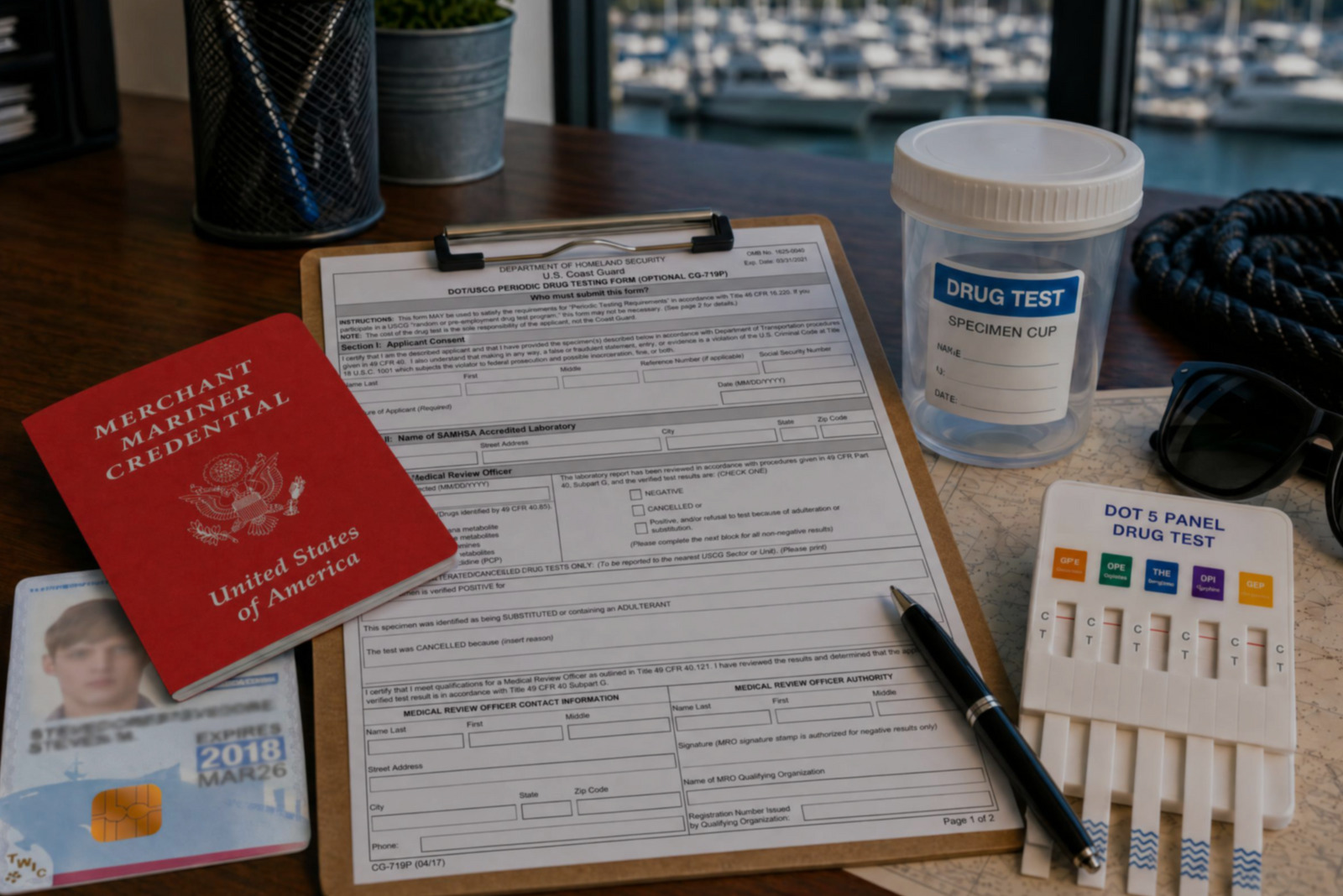

Discover the three types of drug tests working captains must submit to even after they’ve met the initial USCG drug testing requirements for their license.

Discover how a retired airline pilot became obsessed with the Great Loop and built a thriving captain training business through Mariners Learning System.


Learn which substances the MMC drug test looks for, plus how masking agents and false positives factor in.


Discover the five most common mistakes mariners make on the captain’s license physical, plus a checklist for how to avoid them.
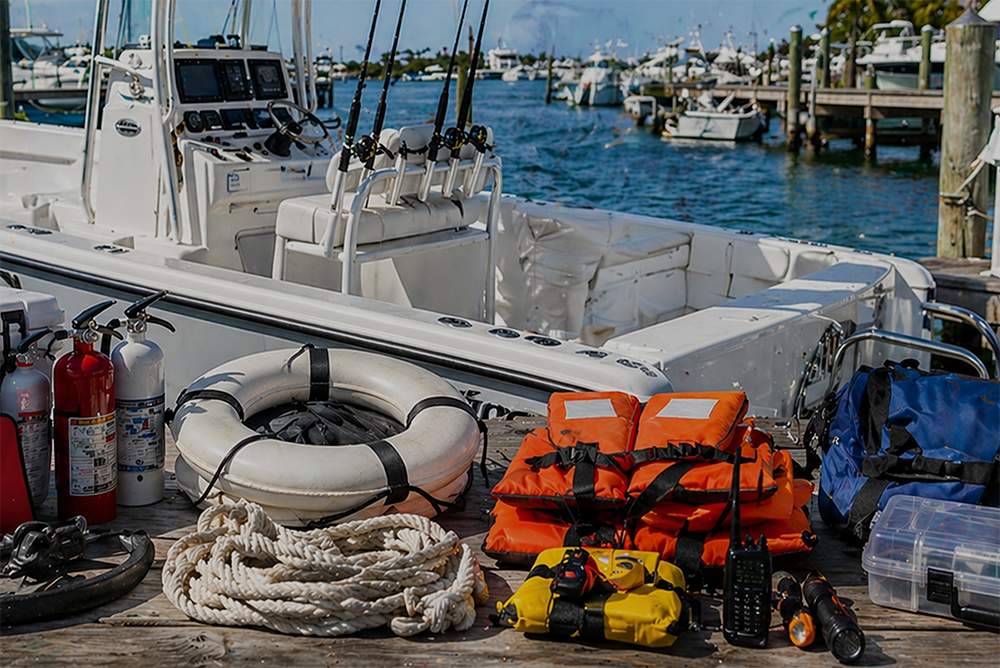

Discover why so many charter captains run out of money and how to plan every startup cost from your vessel purchase to guest-ready outfitting.

Learn how to build a charter business plan that covers pricing, expenses, and marketing so your captain’s license leads to lasting profit.


Transform how you talk about price with proven anchoring strategies and value-first framing that stops charter guests from shopping around.


Discover how charter captains use hybrid pricing models and seasonal adjustments to increase revenue and simplify bookings for every guest type.