

Meet Navi: Your 24/7 AI Instructor Inside the MLS Classroom
Unlock 24/7 access to Navi, an AI instructor trained on MLS course material, so you can ask questions, run practice quizzes, and nail your captain’s exam.
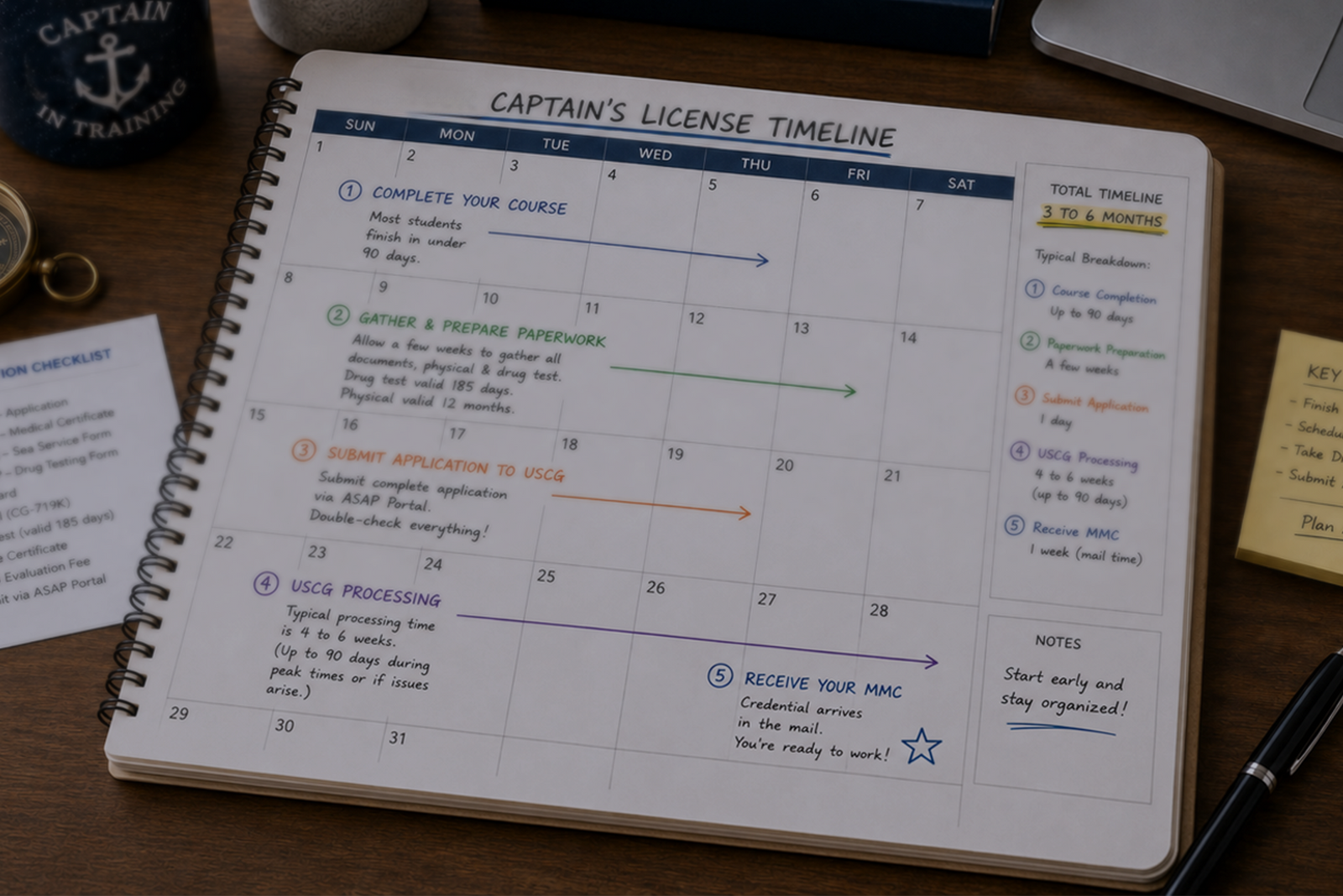

Most students finish their captain's license course in under 90 days, but the full process, from enrollment to a Merchant Mariner Credential (MMC) in hand, typically takes three to six months. The timeline depends on how quickly you complete coursework, document sea time, and gather your physical, drug test, and application paperwork. The U.S. Coast Guard (USCG) then takes four to six weeks (sometimes up to 90 days) to issue your credential.
One of the most common questions we hear at Mariners Learning System is, “How long does it take to get a captain’s license?” The honest answer is that your timeline depends largely on how quickly you complete each step.
Applicants who plan ahead and keep their paperwork straight move through the process in a few months. Those who rush or procrastinate can end up waiting much longer.
Here’s a realistic breakdown of each stage.
The first step is completing a Coast Guard-approved captain’s license course. Whether you are pursuing an OUPV/Six-Pack or Master captain’s license, your training covers essential topics such as navigation, boating safety, rules of the road, and deck operations.
Mariners Learning System courses are fully online and self-paced, allowing you to train around your schedule. You have one full year from activation to complete the program and pass the final proctored exam.
Most students finish in fewer than 90 days. Some complete the course in as little as three days, while others use the full year. Move at the pace that helps you understand and retain the material. You are building practical skills that can help you make safer decisions and protect lives on the water, not simply preparing to pass an exam.
The course length varies by license type and your own pace. The OUPV/Six-Pack course and the Master course both allow up to one year, but most students finish in under 90 days.
After passing the exam, you have one year to use your Mariners Learning System Certificate of Completion. During that time, you must submit your Merchant Mariner Credential application to the National Maritime Center through Navita™.
Your Merchant Mariner Credential and Medical Certificate require separate applications in Navita™. You can prepare many of the supporting documents while completing your course, and you can complete and submit your Medical Certificate application before passing the final exam.
Read More: How to Submit Your Captain’s License Application Packet
Incomplete or inaccurate information is one of the most common causes of application delays. Problems may include:
Coordinate the timing of your requirements carefully. Drug-testing documentation is generally valid for 185 days, while the physical examination is valid for 12 months. Submitting complete, accurate applications from the beginning is the best way to keep your licensing timeline moving.
Submit your Merchant Mariner Credential and Medical Certificate as separate applications through Navita™. The NMC reviews your background, medical fitness, sea service, course completion, and eligibility for the requested endorsement.
Allow up to 90 days for review, although a complete application may be processed in four to six weeks. Your MMC is mailed through USPS, while your Medical Certificate is generally emailed. Because you need both before operating commercially, begin several months before your planned charter season or employment start date.
|
Stage |
Typical Timeframe |
Key Detail |
|
Course Completion |
Under 90 days for most students; up to one year allowed |
Self-paced with one year of access from activation |
|
Application Preparation |
Varies; allow several weeks |
Drug test valid for 185 days; physical examination valid for 12 months |
|
NMC Processing |
Approximately 4 to 6 weeks; allow up to 90 days |
Submit separate MMC and Medical Certificate applications through Navita™ |
|
Credential Delivery |
Varies after approval |
MMC is mailed; the Medical Certificate is generally emailed |
|
Total Typical Timeline |
Approximately 3 to 6 months |
Longer if corrections, additional documents, or a medical waiver are required |
The NMC does not offer expedited application review. The best way to avoid unnecessary delays is to submit complete, accurate MMC and Medical Certificate applications and respond promptly if the NMC requests additional information.
If the NMC needs another document, sign in to Navita™, select Contact Us, and create a case identifying the requested document and the application it belongs to. Upload the document to the case’s Files tab.
MM-SEAS Expert Access, included with your Mariners Learning System captain’s license course, provides guidance about training, courses, sea service, and more!

Several situations can extend your captain’s license timeline beyond three to six months:
Build extra time into your plan. Gather documents as you complete your course, submit your separate Medical Certificate application when it is ready, and respond promptly to any NMC request.
The course and application process follow the same stages for both license types, and the minimum sea time is the same: 360 days of documented boating experience. Those 360 days qualify you for an OUPV/Six-Pack or a Master Inland license. The Master Near Coastal is the version that requires 720 days, with at least 360 on offshore waters (per the NMC checklist).
The Master course includes additional online coursework and a final exam beyond what the OUPV covers, but most students say that the extra portion is straightforward. If your end goal is a Master captain's license and you meet the requirements, go for it from the start. Earning the OUPV first and upgrading later means dealing with the Coast Guard a second time and paying a second application fee.
|
Requirement |
OUPV/Six-Pack |
Master Inland |
Master Near Coastal |
|
Minimum Age When Submitting |
18 |
19 |
19 |
|
Sea Time |
360 days total |
360 days total |
720 days (360 on offshore waters) |
|
Course Length Access |
Up to one year |
Up to one year |
Up to one year |
|
Application Forms |
Same set |
Same set |
Same set |
|
Processing Time |
4 to 6 weeks (up to 90 days) |
4 to 6 weeks (up to 90 days) |
4 to 6 weeks (up to 90 days) |
If you already hold an OUPV/Six-Pack and want to upgrade to a Master, you’ll take a shorter upgrade course and submit a new application.
If you already qualify for a Master license based on your sea service, earning the Master from the beginning may be the more efficient path because it avoids a second course and application process.
Your captain’s license is valid for five years. To renew, document 360 days of sea time earned during the prior five years, or complete the Deck License Renewal course if you fall short. Renewal also requires a new physical, a drug test, and an updated application.
You can start the renewal process up to eight months before your expiration date. If your license expires, you have a grace period during which you can still renew, but you can’t operate commercially. Go beyond the grace period, and you may have to restart the full licensing process.
Your captain’s license (formally, your Merchant Mariner Credential) is valid for five years. You’ll need to renew it before it expires to continue operating commercially.
Yes. At Mariners Learning System, you take the final proctored exam online at your convenience after completing the course. No trip to a Regional Exam Center required.
You can start your course and build sea time simultaneously. Many students begin logging days on the water while they study. Just make sure you have the required sea time documented before submitting your application.
The OUPV/Six-Pack course and exam costs $695. The Master course and exam costs $895. Both include the exam with no surprise fees. You’ll also pay for your physical, drug test, TWIC card, CPR and first-aid training, and Coast Guard evaluation fee separately.
The captain’s licensing process rewards preparation, not speed. Give yourself an honest three to six months, stay organized, and keep your paperwork clean. That credential will be worth every bit of the effort.
If you have questions about the captain’s license timeline or any other part of the application process, the team at Mariners Learning System is here to help. We’ve guided more than 200,000 students through this process, and we’re not going to let paperwork be the reason you don’t get your license.

Regulations and processing times change. Confirm all requirements with the National Maritime Center or a licensing specialist before submitting your application. This article is for informational purposes and does not constitute legal advice.
Ask a question, share an experience, or add a helpful tip related to this article. Comments may appear after review to prevent spam.
Unlock 24/7 access to Navi, an AI instructor trained on MLS course material, so you can ask questions, run practice quizzes, and nail your captain’s exam.


Learn what questions to ask and how to prepare for a captain’s license drug test to ensure you avoid the most common application delays.
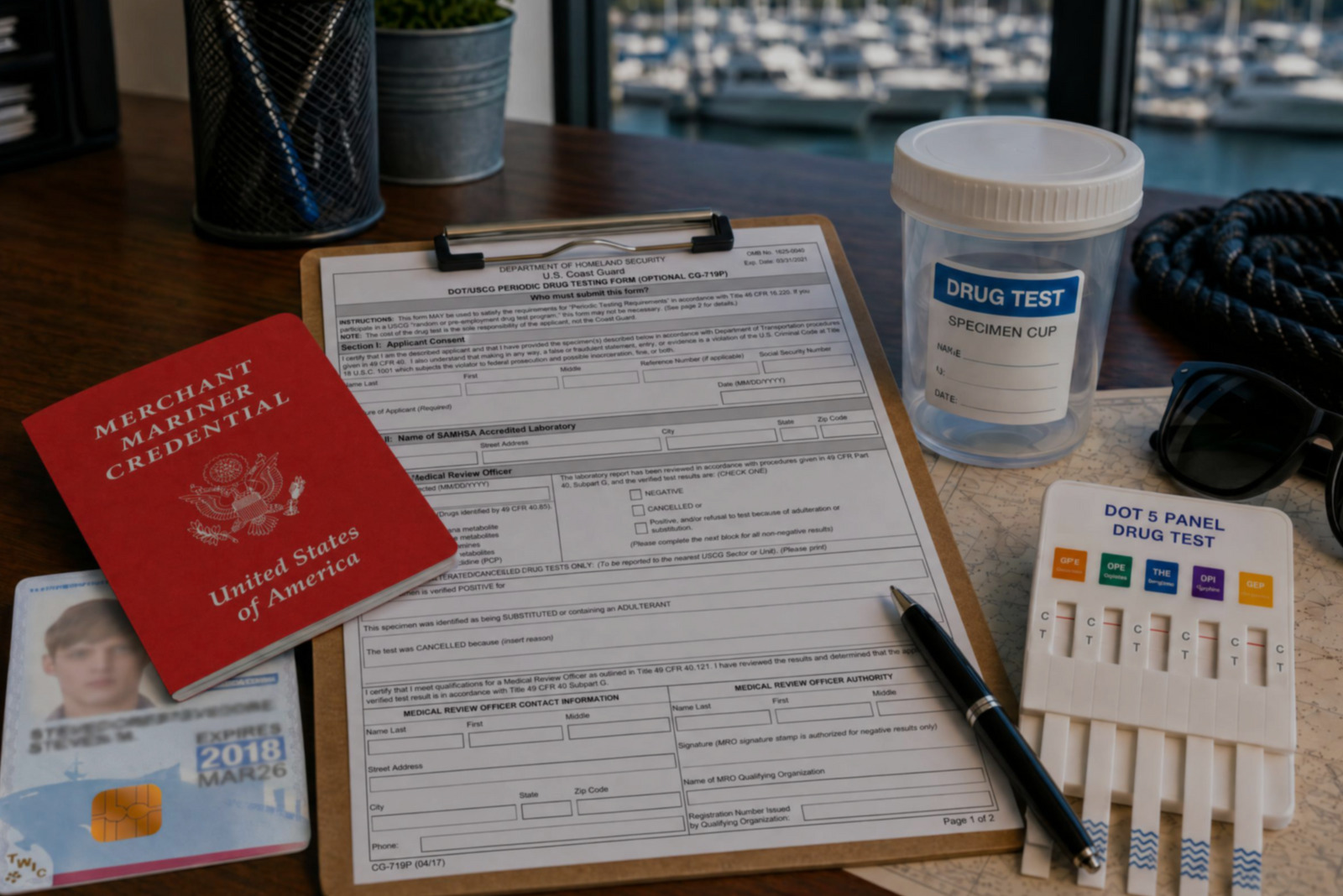

Discover the three types of drug tests working captains must submit to even after they’ve met the initial USCG drug testing requirements for their license.
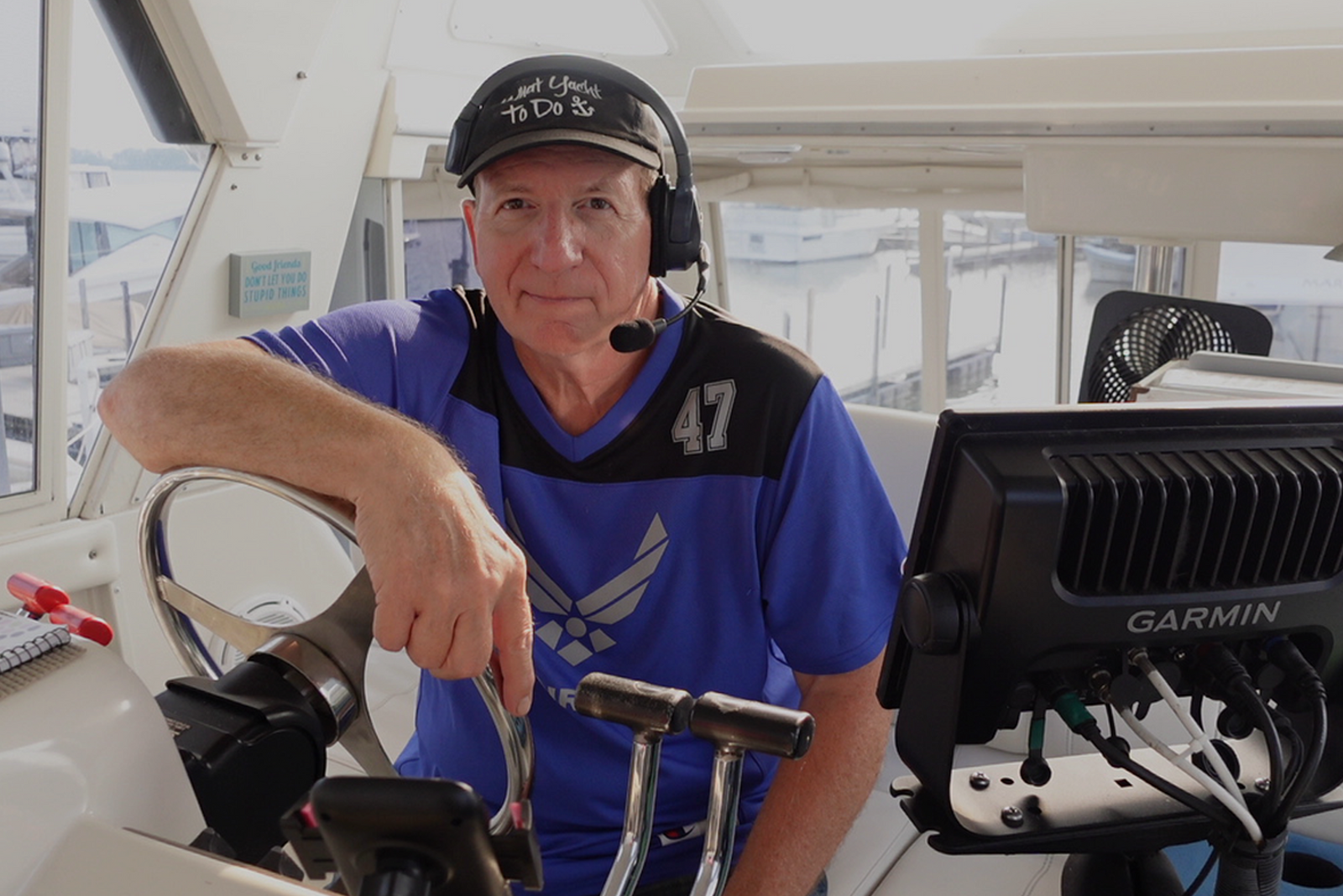

Discover how a retired airline pilot became obsessed with the Great Loop and built a thriving captain training business through Mariners Learning System.

Learn which substances the MMC drug test looks for, plus how masking agents and false positives factor in.


Discover the five most common mistakes mariners make on the captain’s license physical, plus a checklist for how to avoid them.

Discover why so many charter captains run out of money and how to plan every startup cost from your vessel purchase to guest-ready outfitting.

Learn how to build a charter business plan that covers pricing, expenses, and marketing so your captain’s license leads to lasting profit.

Transform how you talk about price with proven anchoring strategies and value-first framing that stops charter guests from shopping around.

Discover how charter captains use hybrid pricing models and seasonal adjustments to increase revenue and simplify bookings for every guest type.